News
March 4, 2026
AI and Customer Relations: What PwC reveals... and how agency AI is finally redefining the customer experience

Customer expectations in 2025, pressure on costs, technological debt, technological debt, intelligent automation, voice AI agents: complete decryption and feedback from the PwC breakfast with Bouygues Telecom, Concentrix and Volubile.
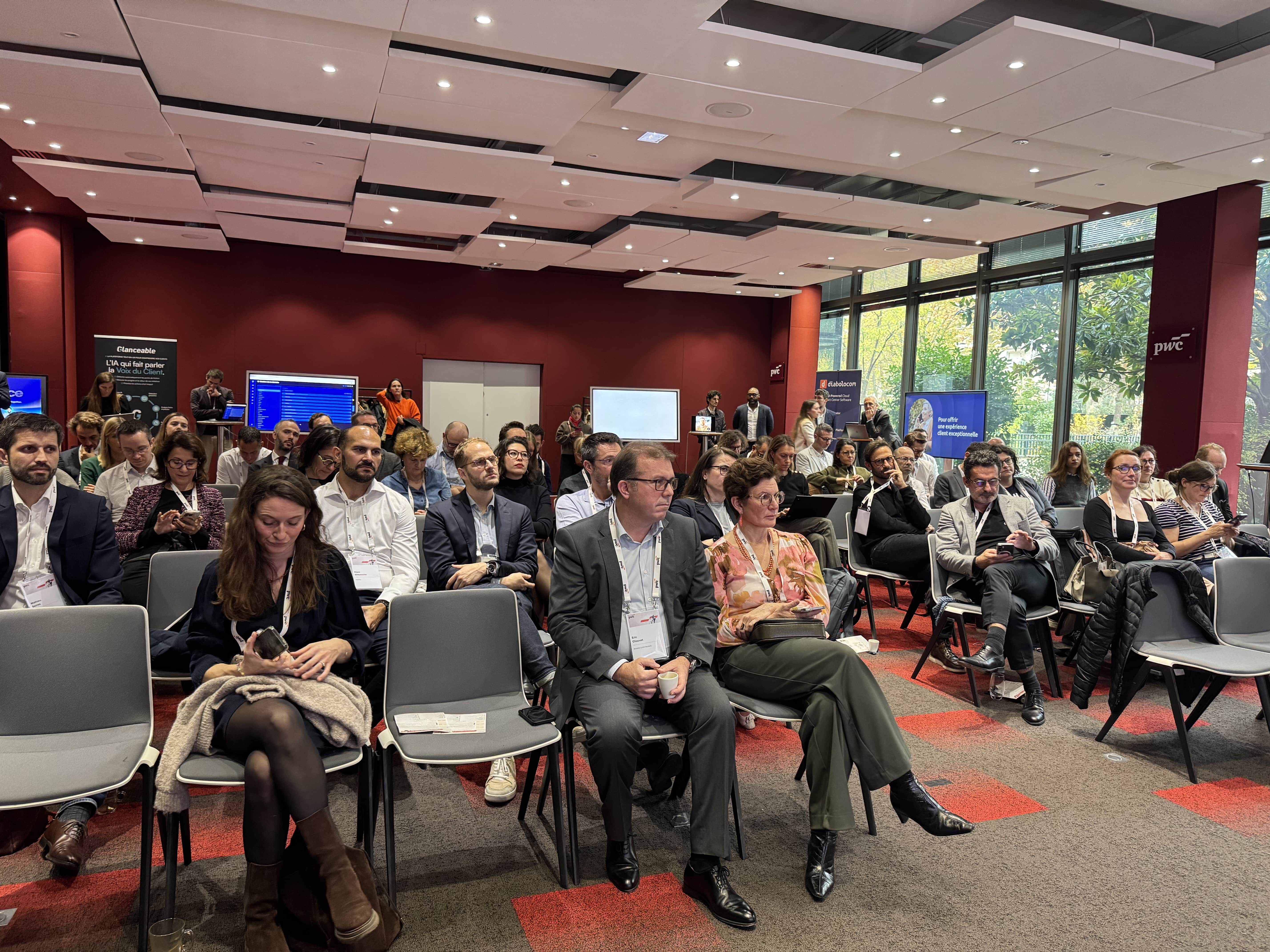
Customer relationships are changing rapidly. Consumer expectations have never been higher, while customer services are facing increasing pressure on costs and the legacy of past transformations. In this context, generative and agentic AI is emerging as a strategic response. During the last event dedicated to innovation in customer relationships organized by PwC on November 6 “AI & customer relationship transformation”, I shared my vision on the impact of conversational and agentic AI to reinvent the customer experience.
This article is based on the results of the study PWC's AI Agent Survey to analyze the challenges and solutions that are redefining customer relationships.
Customer expectations in 2025: a major challenge
Speed, quality and personalization became essential standards in customer relationships in 2025. The numbers speak for themselves:
- 88% customer service professionals say customer expectations are higher than before.
- 64% of customers say they will switch to a competitor if the company does not offer good customer service.
- 90% of customers consider an “immediate” response essential or very important — including 60% Define “immediate” as 10 minutes or less
- 68% of customers consider the resolution rate at first contact to be essential.
Consumers now expect answers that are fast, accurate, and available at all times. At the slightest friction: too long waiting time, poor orientation, inaccurate information; they switch to the competition.
For businesses, this requires a clear choice: invest in technologies capable of managing high volumes of interactions, guarantee a constant quality of response and absorb peaks in activity without degrading the service.
Cost pressure and the limits of past transformations
Digitalization and self-service have been adopted to reduce costs. However, these initiatives have not always made it possible to control expenses, in particular due to the increase in contact volumes. Customer services are facing a paradox: offering a premium experience while optimizing costs.
In addition, there is a Counsellor churn on the rise, combined with recruitment difficulties. Requests are becoming more complex, and the retention of advisors is becoming a strategic issue. This tension has a direct impact on the quality of the customer experience.
Technological debt and data silos: a major obstacle
Customer service departments must deal with significant technological debt and data silos that hamper digitalization. Information is scattered and systems are poorly integrated, which limits the ability to provide a smooth and personalized experience. This fragmentation affects the customer experience as well as that of employees.
AI as a solution: generative and agentic
The enthusiasm for generative and agentic AI is explained by their ability to solve this dilemma: improve quality while reducing costs.
Among businesses using AI agents:
- 66% are seeing an increase in productivity.
- 57% make savings.
- 55% are seeing a faster response.
- 54% improve the customer experience.
In addition, 88% of customer service leaders plan to increase their AI budget in the next 12 months, mainly to automate customer relationships.
Why is AI a game changer?
- Intelligent automation : AI makes it possible to take care of repetitive tasks such as entering data, managing simple requests or updating customer information. This frees up time for human advisors, who can focus on high-value interactions and solving complex problems.
- Large-scale customization : thanks to predictive and conversational analysis, AI can anticipate customer needs, offer adapted recommendations and adjust the tone and content of exchanges according to the profile and context. This ability to offer a tailor-made experience, even to millions of customers, is a powerful driver of loyalty.
- 24/7 availability : AI agents ensure a continuous presence, without interruption, to respond to requests at all hours. This availability improves customer satisfaction, reduces processing times, and reinforces the perception of an attentive and responsive brand, regardless of the time zone or workload.
Concrete use cases: the use of Volubile
To optimize customer relationships, using solutions that combine conversational and agency AI such as Volubile take on a strategic dimension:
- Smart voice agents : Volubile creates AI phone agents that can manage incoming and outgoing calls on a large scale. They respond to requests, take orders, set appointments and provide personalized follow-up, 24/7, with a voice quality indistinguishable from a human.
- Automated appointment scheduling : Volubile agents coordinate calendars via integrations like Google Calendar or Salesforce, by sending automatic confirmations by SMS or email to reduce absences and improve satisfaction.
- Analysis and optimization of interactions : The Volubile platform extracts key data from conversations to anticipate needs, qualify leads and provide accurate KPIs. This intelligence makes it possible to adjust commercial strategies and offer an ultra-personalized customer experience.
These solutions don't just improve the customer experience: they transform operational efficiency by reducing costs, increasing productivity, and providing a smooth and human experience, even at scale.
Perspectives and trends
According to Gartner and Salesforce, agentic AI will represent an increasing part of investments in the next 3 years. Businesses that adopt these technologies now will benefit from a sustainable competitive advantage.
Conclusion
Customer relationships have become a strategic performance factor. In a context of constrained costs and high expectations, generative and agentic AI offers a concrete answer. The PwC figures are clear: businesses that invest in AI improve productivity, reduce costs, and increase customer satisfaction.
The future of customer relationships is being decided now. And as I mentioned, the challenge is no longer to add new technology, but to completely rethink the paths to make them more fluid, faster and totally results-oriented.
Updated on :
April 9, 2026