Features
Voice & Conversation
Voice agents that understand, adapt and act, Like a human
Contextual understanding, ultra-realistic voices and real-time multilingual management

<800ms
Median latency measured under real production conditions
100+
Ultra-realistic voices, customizable in speed, tone and expressiveness
50+
Languages supported, with automatic detection and real-time switching

01 · CUSTOMIZABLE VOICES
Customizable human voices
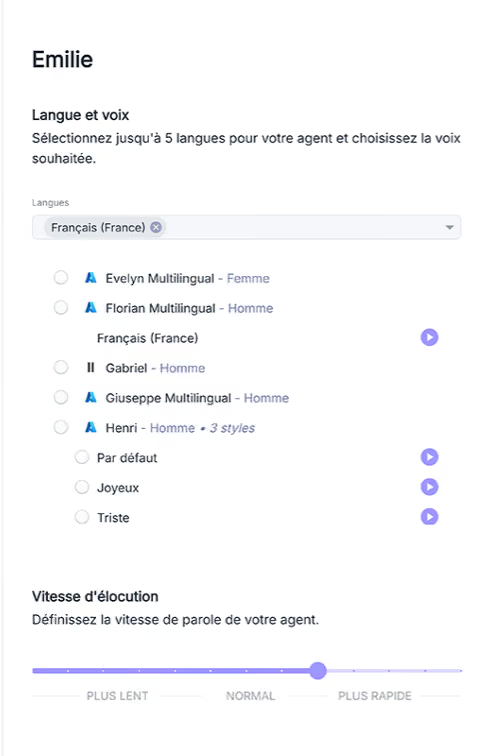
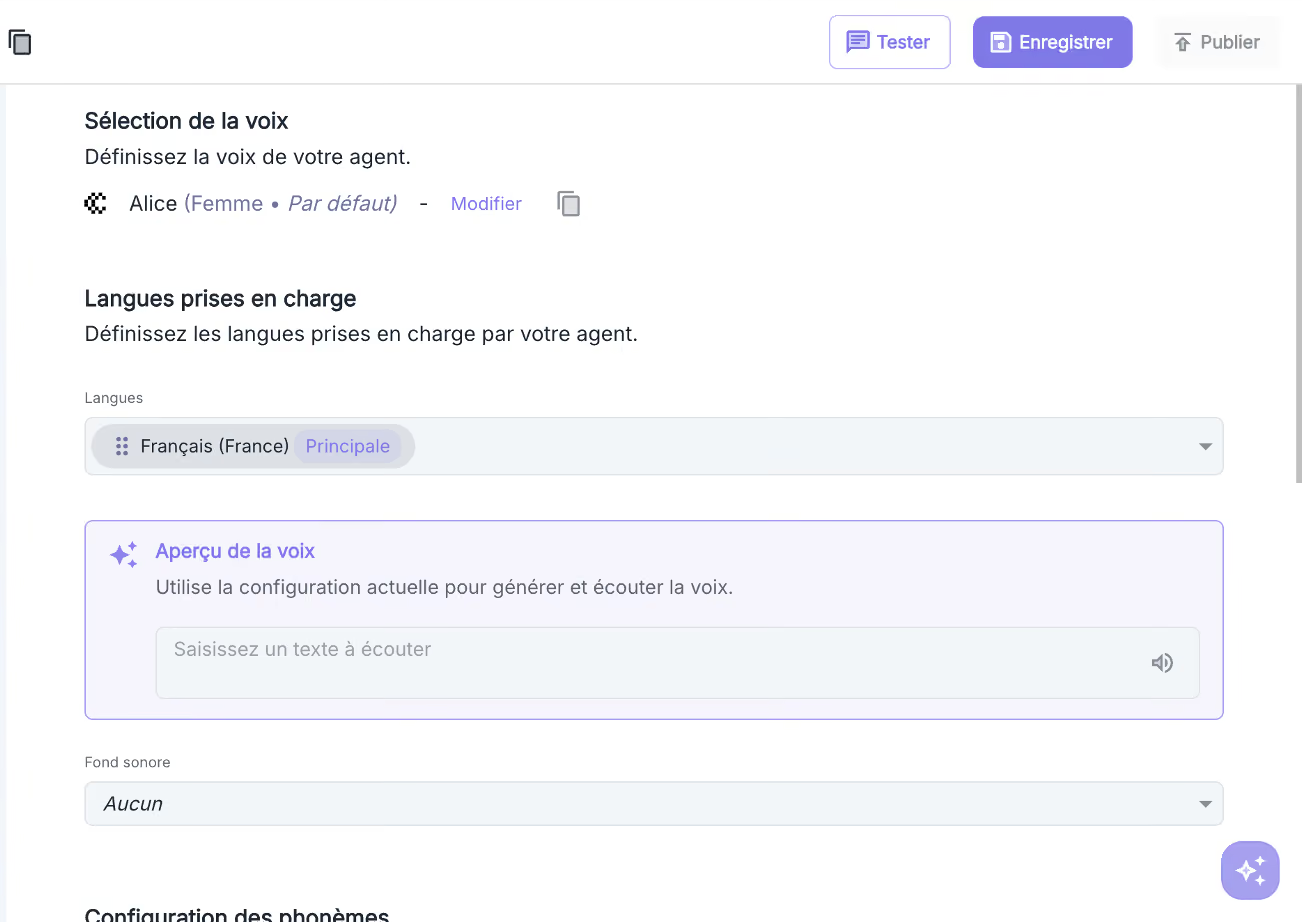
100+ ultra-realistic voices, adjustable in speed, tone and expressiveness. Female, male, neutral — configurable for every context.
100+ Ultra-Realistic Voices, Fully Customizable
Female, male, neutral, adjustable speed. Option to clone a human voice to extend a brand's sonic identity.
Real-Time Tone Adjustment
Frustration, confusion, urgency: detected in real-time. The agent's tone and pace automatically adapt in sensitive contexts like complaints or claims.
Voice Cloning and Brand Voice Identity
Reproduce an existing voice and associate it with your agent.
Phonetic Configuration
Adjust pronunciation word-by-word for each enabled language. Technical terms, proper names, and abbreviations are pronounced exactly as you define.
02 · UNDERSTANDING & INTERACTIONS
A conversation that adapts, not a script
Fully asynchronous STT + LLM + TTS pipeline. Median latency below 600 ms. The agent listens, understands and responds with no perceptible delay.

Contextual Understanding
Long sentences, accents, hesitations, multiple intents: Volubile AI agents maintain context throughout the call, even after interruptions.
Latency
< 600ms: Transcription, generation, and synthesis run in parallel. Audio playback starts before text processing completes. No silence, no perceptible delay.
Turn-Taking and Interruption Handling
Proprietary VAD + language model: silence thresholds dynamically adapt to context. The agent doesn't cut off, doesn't leave gaps. If interrupted, conversational context is immediately reinjected.
Real-time Knowledge Base
The agent draws in real-time from your internal knowledge base, product documentation, FAQs, and procedures to answer with precision, without hallucination.
03 · MULTILINGUAL
Volubile AI voice agents operate natively in over 50 languages
Automatic detection within the first seconds. Seamless switching during the call, with no redirection or interruption.
50+ Languages Available
Voice, pronunciation, and speech rate are configurable for each enabled language.
Language Change Detected in Real Time
The caller switches language mid-call: the Volubile agent detects and switches language immediately, without redirection or interruption.
04 · PRODUCTION GRADE
Built to operate at scale
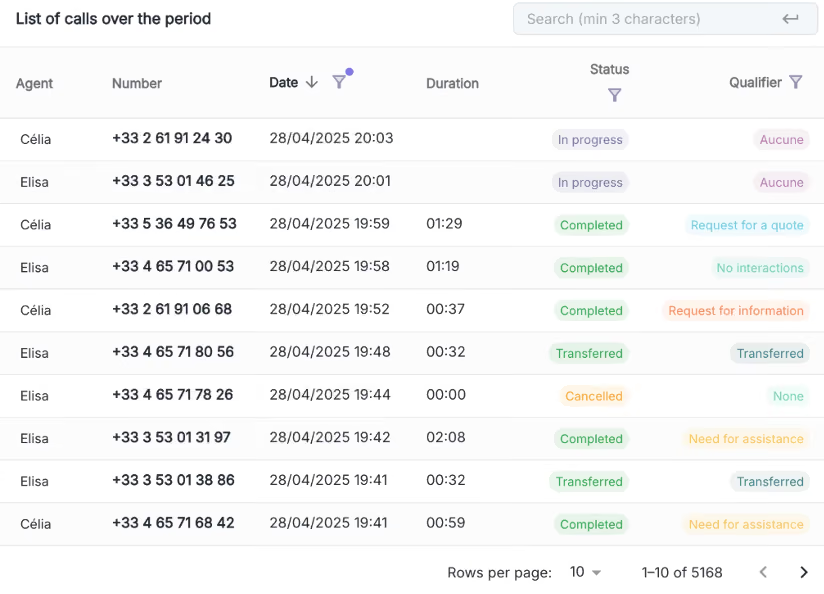
The same conversational quality is maintained across thousands of simultaneous calls, with no degradation in latency or response consistency.
Thousands of Simultaneous Calls
Infrastructure handles traffic spikes without degrading user experience. Up to 3,000 simultaneous conversations in production.
Same Quality for Every Call
Conversation remains stable and controlled, regardless of volume or operational context.
Designed for Large-Scale Operation
Not just an impressive demo: a conversational layer capable of operating under real conditions on critical flows and at large scale.

AIDe & Support
Questions fréquentes
Tout ce que vous devez savoir sur les agents vocaux IA Volubile.
Encore une question ? Contactez-nous.
What is the difference between a Volubile voice agent and a classic IVR?
An IVR requires multi-choice menus and only understands predefined keywords. A Volubile agent understands natural language in all its complexity — long sentences, accents, hesitations, multiple intentions — and maintains context throughout the call. The caller speaks naturally, the agent understands and acts.
What does 800ms latency actually mean?
It's the time between the end of the caller's sentence and the beginning of the agent's response. Below 800ms, this latency is imperceptible to the human ear — the threshold below which a conversation feels natural. It's achieved through a fully asynchronous STT + LLM + TTS pipeline: transcription, generation, and synthesis run in parallel, with audio playback starting even before processing is complete.
How does the agent handle interruptions during a call?
Volubile's proprietary VAD (Voice Activity Detection) system dynamically adjusts silence thresholds based on the conversation's context. If the caller interrupts the agent, the conversational context is immediately re-injected — the agent picks up seamlessly without losing any exchanged information. No dead air, no repeating, no "I didn't catch that."
Does the agent truly understand accents and spontaneous speech?
Yes. The speech recognition engine is trained on real conversational data — not just on articulated speech. Regional accents, hesitations, unfinished sentences, mid-sentence corrections: the agent maintains understanding and context without asking the caller to rephrase.
Can an existing voice be cloned and associated with an agent?
Yes. Volubile allows you to replicate an existing voice — a brand voice, a voice actor's voice, or an internal advisor's voice — and associate it with your agents. Once cloned, the voice can be configured for speed, pitch, and expressiveness just like any voice from the library. Cloning is subject to the explicit consent of the voice owner.
Can the agent adjust their tone based on the emotion detected in the caller?
Yes. Frustration, confusion, urgency: detected in real-time during the call. The agent's tone and pace automatically adjust — more composed for a complaint, more dynamic for a sales qualification. This adaptation is particularly useful for sensitive calls: claims, overdue payments, critical support.
How does in-call multilingual management work?
From the very first seconds, the agent detects the spoken language and adapts to it. If the caller switches languages during the conversation — a common occurrence in Belgium, Switzerland, or international markets — the transition is immediate and seamless: no redirection, no interruption, no requests for repetition. Over 50 languages are available, with voice and pronunciation independently configurable for each.
How do I configure the pronunciation of industry-specific terms?
Volubile's phonetic configuration allows you to define the exact pronunciation word by word in each activated language. Brand names, product references, industry abbreviations, acronyms: anything a generic dictionary would mispronounce can be precisely corrected. Configuration is done directly from the interface, without technical intervention.
How many voices are available and how do I choose them?
The library includes 100+ ultra-realistic voices — female, male, and neutral — available in numerous languages and regional variants. Each voice can be configured for speed, pitch, and expressiveness. You can test the voices in real-world conditions from the sandbox before any production deployment.
Is conversational quality maintained at scale?
Yes. The same quality—latency, comprehension, and response consistency—is guaranteed whether the agent handles 1 call or 3,000 simultaneously. The infrastructure is scaled for peak loads without noticeable degradation. The 99.8% SLA is measured in production across all active clients.
They trust us


.avif)